
- Somnath Temple

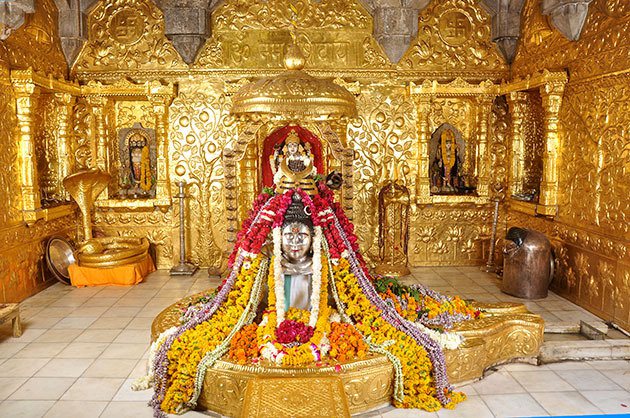
Somnath is traditionally considered the first pilgrimage site: the Dwadash Jyotirlinga pilgrimage begins with the Somnath Temple. The temple, that was destroyed and re-built sixteen times, is held in reverence throughout India and is rich in legend, tradition, and history. It is located at Prabhas Patan (Somnath- Veraval) in Saurashtra region of Gujarat state in western India.
2 . Mallikarjuna Temple


Malllikarjuna, also called Srisaila, is located on a mountain in Kurnool District in Rayalaseema. It enshrines Mallikarjuna in an ancient temple that is architecturally and sculpturally rich. It is a place where Shakti peetha and Jyotirlingam are together. AdiShankara composed his Sivananda Lahiri here.
3. Mahakal Temple


Mahakal, Ujjain (or Avanti) in Madhya Pradesh is home to the Mahakaleshwar Jyotirlinga temple. The Lingam at Mahakal is believed to be Swayambhu, the only one of the 12 Jyotirlingams to be so. It is also the only one facing south and also the temple to have a Shree Yantra perched upside down at the ceiling of the Garbhagriha (where the Shiv Lingam sits). It is a place where Shakti peeta and Jyotirlingam are together.
4. Omkareshwar Temple


Omkareshwar is in Madhya Pradesh on an island in the Narmada River and home to a Jyotirlinga shrine and the Mamaleshwar temple
5. Kedarnath Temple

Kedarnath in Uttarakhand is revered as the northernmost and the closest Jyotirlinga to Lord Shiva's eternal abode of Mount Kailash. Kedarnath forms a part of the smaller Char Dham pilgrimage circuit of Hinduism. Kedarnath, nestled in the snow-clad Himalayas, is an ancient shrine, rich in legend and tradition. It is accessible only for six months a year. It is also one of the Padal Petra Stalam of Vada Naadu mentioned in Thevaaram. Shiva assumed the form of wild boar and dived into the earth at Kedarnath to emerge at Pashupatinath. Pure ghee is applied at Kedarnath lingam as the boar was injured
6. Bhimashankar Temple

Bhimashankar is very much debated. There is a Bhimashankara temple near Pune (pictured) in Maharashtra, which was referred to as Daakini country, but Kashipur in Uttarakhand was also referred to as Daakini country in ancient days and a Bhimashkar Temple known as Shree Moteshwar Mahadev is present there. Another Bhimashankar is in the Sahyadri range of Maharashtra. The Bhimashankar temple near Guwahati, Assam is the jyotirlinga according to Sivapuran. According to Linga Purana, Bhimasankar temple in Bhimpur near Gunupur of Rayagada district in South Orissa is also believed as Bhimasankar Jyotirlinga, which is situated at the western part of the holy Mahendragiri mountains and at the river bank of Mahendratanaya(which is also believed as the Daakini area by many historian), was excavated in the year 1974, having quadrangular Shakti around the Linga and decorated by a Upavita as per the puran.
7. The Kashi Vishwanath Temple

The Kashi Vishwanath Temple in Varanasi, Uttar Pradesh is home to the Vishwanath Jyotirlinga shrine, which is perhaps the most sacred of Hindu shrines. It is also one of the Padal Petra Stalam of Vada Naadu mentioned in Thevaaram.

The temple is situated in Varanasi, the holiest city for Hindus, where a Hindu is expected to make a pilgrimage at least once in his life, and if possible, also pour the remains of cremated ancestors on the River Ganges. The temple stands on the western bank of the holy river Ganges, and is one of the twelve Jyotirlingas. In fact, it is a place where Shakti peeta and Jyotirlingam are together. It is the holiest of all Shiva temples. The main deity is known by the name Vishwanath orVishweshwara meaning Ruler of the universe. The temple town, which claims to be the oldest living city in the world, with 3500 years of documented history, is also called Kashi.
8. Trimbakeshwar Temple

The Trimbakeshwar Temple, near Nasik in Maharashtra, is a Jyotirlinga shrine associated with the origin of the Godavari River.

Baidyanath Jyotirlinga temple, also known as Baba dham and Baidyanath dham is one of the twelve Jyotirlingas, the most sacred abodes of Shiva. It is located in Deoghar in the Santhal Parganas division of the state of Jharkhand, India. It is a temple complex consisting of the main temple of Baba Baidyanath, where the Jyotirlinga is installed, and 21 other temples.

According to Hindu beliefs, the demon king Ravana worshipped Shiva at the current site of the temple to get the boons that he later used to wreak havoc in the world. Ravana offered his ten heads one after the another to Shiva as a sacrifice. Pleased with this, Shiva descended to cure Ravana who was injured. As he acted as a doctor, he is referred to as Vaidhya ("doctor"). From this aspect of Shiva, the temple derives its name.
10. Nagesh Temple

Nagesh Jyotirlinga is one of the 12 Jyotirlinga shrines mentioned in the Shiva Purana (Satarudra Samhita, Ch.42/2-4, referred as "nagesham darukavane"). Nagesh is believed as the first Jyotirlinga on the earth.
 There are three major shrines in India which are believed be Jyotirlinga. the Nageshvara templenear Dwaraka in Gujarat state and the Jageshwar temple near Almora in Uttarakhand state.other Naagnath temple which is believed to be Jyotirlinga
11. Rameshvaram Temple


Rameshvaram in Tamil Nadu is home to the vast Ramalingeswarar Jyotirlinga temple and is revered as the southernmost of the twelve Jyotirlinga shrines of India. It enshrines theRameśvara ("Lord of Rama") pillar. It is also one of the Padal Petra Stalam of Pandya Naadumentioned in Thevaaram.
12. Ghushmeshwar Temple

Ghushmeshwar Jyotirlinga is one of the twelfth Jyotirlinga shrines mentioned in the Shiva Purana "kotirudra sahinta", referred as ghushmeshwar jyotirlinga. Ghushmeshwar is believed as the last or twelfth Jyotirlinga on the earth.